

Why Order by August Cuts 30% Cost
2026-07-28 18:12
📅 The Q4 Food Packaging Procurement Timeline
Procurement managers across North America and Europe now face the single most important decision of Q4 2026. July marks the inflection point where lead times still allow ocean freight delivery before the Halloween peak in late October. For chain restaurants planning seasonal menus and packaging wholesalers stocking holiday inventory, placing orders now determines whether the final quarter runs smoothly — or becomes an expensive logistical scramble.
The full purchasing cycle — from purchase order to DC-ready inventory — requires 12 to 15 weeks minimum for food packaging manufactured in Asia and shipped to North America.
Standard Lead Time: Step by Step
| Phase | Duration | What Happens |
|---|---|---|
| 🎨 Artwork Approval & Pre-Press | 1–2 weeks | Design files reviewed, printing plates made, color proofs approved |
| 🏭 Production | 4–6 weeks | Raw material procurement, forming, printing, cutting, QC inspection |
| 🚢 Container Loading & Export | 1 week | Container stuffing, China customs export declaration, vessel departure |
| 🌊 Ocean Freight (Asia → NA West Coast) | 3–4 weeks | Trans-Pacific transit to Los Angeles / Long Beach or Vancouver |
| 🌊 Ocean Freight (Asia → NA East Coast) | 5–6 weeks | Panama Canal or Suez routing to New York, Savannah, or Houston |
| 🛃 Customs Clearance & Drayage | 1–2 weeks | FDA prior notice, CBP clearance, chassis availability, inland rail/truck |
| 📦 Inland Distribution | 1–2 weeks | DC receipt, putaway, allocation to regional fulfillment hubs |
| Total (West Coast) | 11–15 weeks | From PO issuance to DC-ready inventory |
| Total (East Coast) | 13–17 weeks | Longer ocean transit adds 2+ weeks |
Count Backwards From Halloween
For Halloween-themed paper bowls and wholesale containers to reach shelves by October 15:
Oct 8 — Distribution centers must receive inventory (1 week for allocation)
Sep 24 — Vessel must arrive at port (2 weeks for customs + drayage)
Aug 20 — Vessel must depart Asia (5 weeks ocean transit with buffer)
Aug 13 — Production must complete (1 week for loading + export)
Jul 28 — TODAY — Purchase order must be issued
⚠️ Reality Check: One port congestion event, one customs hold, or one raw material shortage — and the entire food packaging delivery schedule slides by weeks. The July–August window is not conservative planning. The July–August window is the realistic timeline.

💰 What Delayed Ordering Costs — Real Numbers
The cost difference between a July order and a September order involves far more than the unit price on a factory quotation. Three cost layers compound simultaneously: unit pricing, freight rates, and rush surcharges.
| Cost Component | July Order | September Order | Increase |
|---|---|---|---|
| Unit Price (factory at 60–70% capacity) | $0.048/unit | $0.060/unit | +25% |
| Ocean Freight (per 40HC container) | $3,200 | $5,800 | +81% |
| Rush Production Surcharge | None | 15–25% on top | +15–25% |
| Total for 500,000 paper bowls | $27,000 | $36,000 | +33% |
By October, the procurement equation breaks completely. Ocean freight transit no longer guarantees arrival before holiday shelf dates. Emergency air freight becomes the sole option. Consolidated air cargo from Shanghai to Los Angeles costs $4.50–$6.00 per kilogram, translating to $45,000–$60,000 in freight charges alone for a container-equivalent volume of disposable food containers.
Freightos Baltic Index data: Q4 2025 ocean spot rates from Asia to US West Coast spiked from $2,100/40HC in July to $6,700/40HC in October — a 219% increase in three months.
🏭 Why Factory Capacity Creates a Pricing Cliff
Food packaging factories operate on fixed production line capacity. A typical facility in Fujian, China runs 8–12 lines producing 300,000–500,000 units per day. Capacity utilization follows a predictable seasonal curve with dramatic cost consequences.
| Month | Factory Utilization | Buyer Experience |
|---|---|---|
| July | 60–70% | ✅ Flexible scheduling, normal QC, design changes accepted |
| August | 70–80% | ✅ Good availability, standard lead times |
| September | 90%+ | ⚠️ Fixed slots, compressed QC, no design changes |
| October | 100%+ overtime | ❌ "We will try" — no delivery date guarantees |
By September, manufacturing utilization across the food packaging industry climbs past 90 percent as holiday orders from multiple buyers converge. Factories charge rush premiums of 20–40% above standard pricing for paper bowls and wholesale containers placed after the August cutoff for bulk packaging and container orders. Ocean freight carriers release Q4 rate increases, driving spot prices 100–219% above July levels for food packaging shipments.
🎯 Five Strategies Top Procurement Teams Use Now
Pre-Book Production Slots Early
Reserve manufacturing capacity using framework purchase orders for wholesale containers while finalizing seasonal artwork in parallel. Decoupling the creative timeline from the production timeline saves 2–3 weeks and guarantees a factory slot before peak-season allocation fills for food packaging buyers. Securing bulk packaging production windows early provides cost certainty through the volatile Q4 pricing period.Lock Ocean Freight Contracts in July
Negotiate ocean freight rates during July — before carriers announce Q4 General Rate Increases in late August. Contract rates locked in July for September–November sailings price 40–60% below the spot market rates materializing in October for bulk packaging shipments.Build a 30% Safety Stock Buffer
Maintain a 20–30% buffer above marketing forecast quantities for disposable food containers SKUs. Incremental carrying cost (~$0.001–0.002/unit/month) is dwarfed by stockout losses — estimated at $15,000–$50,000 per day per location for QSR chains (QSR Magazine, 2025).Pre-Qualify Backup Material Specifications
Approve unprinted or stock-printed alternatives for each food packaging SKU before the peak window closes. When primary paper bowls production lines reach full allocation, having pre-qualified backups prevents complete order loss.Educate Internal Stakeholders on the Real Timeline
The most common Q4 failure involves internal approval delays — not supplier shortfalls. Marketing teams often finalize seasonal artwork in September, months after the bulk packaging supply chain window for ocean freight delivery has already closed. Share the timeline now.
🔍 2026 Risk Factors to Monitor
Panama Canal Variability — Water level fluctuations continue creating 1–2 weeks of transit uncertainty for disposable food containers shipments routed to East Coast and Gulf Coast distribution centers.
PFAS Regulations Tightening — California AB-1200 and parallel state-level bans continue restricting permissible materials for food-contact food packaging. Importers must verify complete composition documentation before placing Q4 disposable food containers orders.
Record LTO Demand — The National Restaurant Association 2026 Forecast projects 72% of restaurant operators running Q4 seasonal offers (up from 65% in 2025), driving higher demand for custom paper bowls and branded wholesale containers.
🏆 Why ODPACK for Q4 Food Packaging Procurement
ODPACK operates 20 production lines in Xiamen, China with July 2026 capacity still available for Q4 bulk packaging and wholesale containers orders. All paper bowls, food packaging products, and disposable food containers carry full FDA, LFGB, and EU regulatory compliance with third-party verification. The OEM and ODM production team serves chain restaurants, catering distributors, and packaging wholesalers across 40+ countries.
📋 Ready to Secure Your Q4 Packaging?
Contact ODPACK for a Q4 capacity assessment and quotation within 24 hours.
📧info@orderpack.cn | 📞 +86 135 999 10171 | 🌐 www.odpack.com
❓ Frequently Asked Questions
When should procurement managers order food packaging for Q4 2026?
July to mid-August 2026 — the full cycle from PO to DC-ready inventory demands 12–15 weeks, covering production, ocean freight, customs clearance, and inland distribution before the Halloween peak in late October.
How much can early ordering save?
Early ordering saves 15–30% on total procurement costs. A 500,000-unit paper bowls order costs ~$27,000 in July versus ~$36,000 in September. October air freight pushes freight alone to $45,000–$60,000.
What are minimum lead times for custom printed food packaging?
Standard custom printed food packaging: 4–6 weeks production after artwork approval, plus 4–5 weeks ocean freight to North America. Expedited production cuts manufacturing to 3–4 weeks with a 15–25% surcharge.
How to protect against Q4 supply chain disruptions?
Build 20–30% safety stock, diversify across two production lines, pre-book ocean freight by August, maintain backup material alternatives per SKU, and establish escalation protocols with food packaging suppliers.
Related News
Read More >-
![How Does Sushi Push Up Tube Packaging Improve Freshness?]()
How Does Sushi Push Up Tube Packaging Improve Freshness?
Freshness is one of the most important qualities consumers expect from prepared sushi. After sushi is assembled, exposure to moisture, grease, handling, and the surrounding environment can affect its appearance and eating experience. A thoughtfully designed sushi push up tube provides a controlled packaging environment that helps protect the product during storage, transportation, and consumption.
-
![Why Choose Wholesale Sushi Push Up Tube Packaging?]()
Why Choose Wholesale Sushi Push Up Tube Packaging?
As takeaway sushi and ready-to-eat food continue to develop, packaging needs to do more than simply hold a product. Restaurants, retailers, caterers, and food distributors are looking for packaging that combines food protection, convenience, presentation, and efficient purchasing. For these businesses, wholesale sushi push up tube packaging offers a practical format designed around the real needs of modern foodservice.
-
![How Does Sushi Paper Tube Packaging Support Food Safety?]()
How Does Sushi Paper Tube Packaging Support Food Safety?
For takeaway and retail applications, the combination of a suitable sushi paper tube, food-contact-appropriate materials, effective handling procedures, and practical design can create a more reliable packaging solution. As consumers continue to value both convenience and hygiene, well-engineered paper sushi container formats such as the sushi roll tube and sushi push pop can provide useful support for modern sushi businesses.
-
![Food Packaging Certifications: FDA, FSC, CE, BRCGS]()
Food Packaging Certifications: FDA, FSC, CE, BRCGS
FDA, FSC, CE, and BRCGS — four certifications every food packaging buyer asks about. ODPACK decodes what each certificate proves, which markets require it, and how to verify supplier documents before placing wholesale food packaging orders.
-
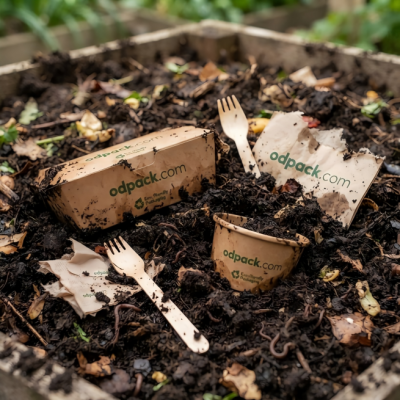
![Compostable vs Recyclable: Choose Right for Foodservice]()
Compostable vs Recyclable: Choose Right for Foodservice
Compostable and recyclable packaging both claim sustainability, but each works only in specific foodservice conditions. ODPACK compares cost, durability, waste infrastructure, and end-of-life outcomes to help buyers choose the right food containers for every application.
-
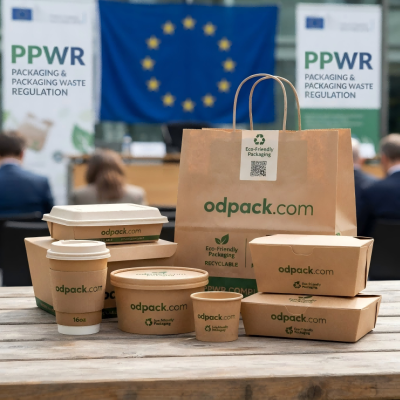
![EU PPWR Effective Aug 12: What Importers Must Do Now]()
EU PPWR Effective Aug 12: What Importers Must Do Now
The EU Packaging and Packaging Waste Regulation takes full effect August 12, 2026, with new PFAS limits on food packaging. ODPACK explains what Asian suppliers and importers must verify, document, and change before shipping into European markets.
-
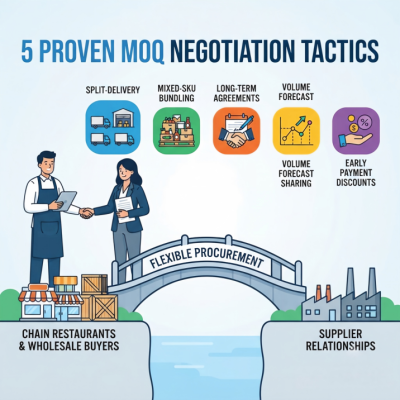
![MOQ Negotiation: 5 Tactics That Work for Chain Buyers]()
MOQ Negotiation: 5 Tactics That Work for Chain Buyers
Minimum order quantity constraints block procurement flexibility for chain restaurants and wholesale buyers. ODPACK presents five proven MOQ negotiation tactics — from split-delivery structures to mixed-SKU bundling — that reduce per-unit risk without harming supplier relationships.
-
![Plastic Packaging Regulations: A 2025-2027 Compliance Timeline]()
Plastic Packaging Regulations: A 2025-2027 Compliance Timeline
From the EU to California to Canada, single-use plastic packaging regulations are accelerating. ODPACK maps every major compliance deadline between 2025 and 2027, showing which food containers, bowls, and packaging categories face mandatory material changes and when.